Thursday, March 20, 2014

THE WONDERFUL CUISINE OF MOROCCO

I Love Moroccan Food!

When I found out that I was going to be visiting Morocco, I had a few questions in my mind:  What would I be eating?  Would I like living in Morocco? Should I wear a scarf on my head since it is a Muslim country? Will I be able to learn any Arabic?Today I will write about food and in my next post I will talk about the hijab (scarf).

The food in Morocco is delicious and nutritious, too.  Some of the dishes that are typically served in most homes and restaurants are:
 
Couscous- a main course dish of very tiny pieces of pasta called semolina which is served on Fridays in Morocco after afternoon prayers.  Couscous usually has a bed of the semolina then many vegetables (carrots, potatoes, onions, squash, pumpkin, chick peas) in a sauce and some type of meat on top.  When this is eaten the traditional way, family style, it comes on a huge round platter and everyone digs in to the closest section of the platter.
                                            (Below)


Crepes- this dish can be a dessert or a main course and comes from France.  Customs that come from France  are a major part of Moroccan culture because the two nations have had very close ties for many years.  French is the second language of the country.  Crepes are very thin pancakes that are then filled with breakfast, lunch or dessert ingredients.  I have had cheese crepes, almond crepes, chocolate crepes and vegetable crepes.  All were very light and very tasty.    Chocolate and Almond Crepe (below)


·     
     Moroccan Khobz- many Moroccan women make bread dough at home and then take it to a bakery to be cooked in large ovens.  Some homes have bread ovens, but if not, then the dough gets dropped off and then picked up later.  The baker punctures the top of each loaf with the initials or other identifying mark of its baker.  This bread is round and a little sweet, so it does not need butter on it.  Most people in Morocco use this bread to scoop food from the serving platters.


Bastilla-  this is a round pie-like dish served as a main course.  Very thin dough is layered and filled with whatever type of bastilla is being cooked.  It can be filled with seafood, vegetables or a meat like chicken, lamb or beef. When I was served this chicken bastilla, it was sweet with cinnamon on the top.  (below)


Tajine- this main course is  a dish named for its special cooking container called a tajine. They are brought to the table in a round clay dish with a uniquely shaped cover.  Tajines contain vegetables and one of a variety of meats like lamb, chicken and beef.


This is what a tajine without cover looks like (above)

This is another type- meat and prune tajine (below)


My pictures show how beautiful the food preparation is here in Morocco.  I wish could bring these foods home with me! However, there are Moroccan restaurants in NJ and PA that I plan to check out.

Saturday, March 15, 2014

Kudos to Moroccan Students- Part 2

Welcome to Ain Aouda (This was an excellent day with lots to share!)

Yesterday I spent the day with my host teacher, Mr. Abdellatif el Moncef, at his high school in Ain Aouda. It is a rural community with many farms. As we drove out from Rabat, we saw herds of cows, sheep, goats and horses as well as men walking beside donkeys with packs on their backs.  The ride through the countryside was quite beautiful.  

Once we arrived at the school, I was introduced by Mr. El Moncef to his classes. Two students in each class had prepared welcome speeches for me and the other teacher from the USA.  There was a sign on the wall that said Mrs. Wilkins and Mrs. Alexander: Welcome to Morocco!  Later, I shared a powerpoint presentation about myself, my family, Kreps School and the two OAmbassador clubs.   When the classes were over, many students waited to have pictures taken with us. They were so friendly and respectful and I felt truly honored by their warm welcome.  


This classroom holds 50 students for most classes and students are required to buy their own books, paper, etc.

Two of the students who gave welcoming speeches.
Mr. El Moncef, three students, Mrs. Wilkins and me.

I also met with their Human Rights Club and did a lesson on Malala, just like the one we did in OAmbassadors.  The Moroccan kids were fascinated by her. They will be writing letters in their English classes to add to the ones you wrote. Then I will send the package of letters to her: American and Moroccan students working together to change the world!  YES!  After the meeting, I passed out the first Loom bracelets from the Kreps kids...see below!


Ain Aouda Human Rights Club members proudly showing off their Loom Bracelets, made by Kreps students for my trip!

The best part was later in the day, when we attended a party at the school. There was a sign on the wall welcoming us to Morocco. First, two students sang a beautiful song in Arabic about the hajjib, the head scarf worn by many of the girls, then we were treated to all kinds of great Moroccan pastries and Moroccan Tea which is out of this world! I  presented more of our Loom Bracelets and all of the students were thrilled to receive these AND to know the names of each bracelet maker.  They didn't take off the name tags on the bracelets so they could remember the American students' names!  I had given the parent association president one, too and he wore his bracelet with appreciation.  

The best surprise for me was when one of the girls came over and designed a beautiful henna tattoo on my hand. See below.


The students served Moroccan Tea, which is made with fresh mint and is delicious!


Friday, March 14, 2014

Kudos to Moroccan Students- Part 1

Languages Spoken in Morocco

The average American student reads and writes one language fluently: English.  My students in East Windsor usually start a foreign language in middle school then continue that language in high school. Many of my students' parents speak a different home language, like Spanish, Hindi or Punjabi, so they probably speak that as well, but may not read or write it.   It is very different in Morocco where schools have some pretty tough requirements to graduate from high school.  

Think about this: What if you were required to use only French in your math and science classes instead of English? That would be a huge surprise for most American students.  However in Morocco, students are expected to master at least 3 and often 4-5 languages in order to graduate from high school.  All students must be able to speak, read and write in Classical Arabic for religious study,  Darija (Moroccan Arabic, which is a different dialect than Classical Arabic), French and increasingly, English. That's not all......Students who belong to an ethnic community called Amazigh speak Tamazight at home and study that at school, too.  For those students in the north close to Spain, Spanish is taught.  There are several other languages spoken in Morocco as well, in the Atlas Mountains and in the Sahara region.  

When I met students at a Moroccan high school yesterday, they spoke English beautifully! I was very impressed.  These  students speak Darija with each other when not in class, then use French in some classes and English in others.  One of the girls I talked with also speaks Tamazight. The Moroccan students' ability to speak so many languages is incredible and it all starts when they learn French in elementary school.   

I have picked up a few phrases in Darija but it is tough!!  Try speaking a few phrases in Darija using this video: Moroccan Arabic Lesson

Wednesday we visited a school that trains Moroccan university students who plan to be English teachers. I had a chance to speak to two young women about their plans to become English  teachers.  Here is a photo of them.  They both speak 4 languages!  


New Question of the Day:  
Look carefully at the picture below- What do you see  grazing in this beautiful countryside about 45 minutes from Rabat?


Wednesday, March 12, 2014

Water, water, water and food, food, food.

Answer to previous Question of the Day

Thank you to Ms. Chavez-Millers classes in New Mexico for the wonderful answers to identify the man in the unusual clothes.  It was so nice to read all of your ideas!  Nobody got it right, though. The man wearing the elaborate costume is what is called a Guarrab or "Water-seller".   On his back he carries a camel skin sack filled with water and on his front,  the metal cups he wears are for serving water to thirsty Moroccans.  In exchange, he receives money.  This job has been around for a very long time and did not pay much.  However, when many people do not have easy access to water, "Watersellers" serve an important purpose in a hot, dry nation.   Click here to see a video about the Guarrabs in Morocco.

Today's New Question of the Day

Identify the food which is in this picture.....


Tuesday, March 11, 2014

Some Sights in Rabat, Morocco's Capital


Today's Questions of the Day:

1. Who is the man standing with me?  Why is he dressed like this?  Hint: Remember that Morocco is in North Africa and some people live in a desert region.

2. Also, do you see anything on my hand?  What is it?


Answer to yesterday's Question of the Day

  Moroccans do not eat PORK.  People who are followers of the religion Islam do not eat any meat that comes from pigs.  No bacon, pork chops, ham, breakfast sausage, etc.  Good try to all who attempted this question. 


Mausoleum of Mohammed V- Father of Moroccan Independence


One of many guards on duty.


Beautiful mosaic tiles are in many places around the Mausoleum.


Monday, March 10, 2014

First full day in Morocco

Absorbing Moroccan Culture.....Day 1!

I finally arrived in Rabat, the capital of Morocco, late yesterday afternoon. Our experience so far has been really fascinating.  We have tasted many new types of food, which I will later post as a food blog entry.  The people of Rabat are friendly and welcoming.  Most I have met so far in our hotel, in shops and at restaurants do not speak English, so I have tried hard to remember my high school French.  To my students who read this: work hard to master the language you are taking in school.  It will help you so much when you travel to other countries!

Arrival pictures: 


Now, I am a student here!

Today we had three workshops with Moroccan teachers of English.  I learned some very interesting facts about Moroccan history and culture that I didn't know.  

  • Morocco was the FIRST nation to recognize the new nation, United States of America, in 1777.
  • The treaty between Morocco and the USA is America's longest UNBROKEN treaty!  We have been friends with Morocco longer than any other country.  
  • In Morocco, students learn 3 languages, sometimes 4 or even 5!  These languages are: Arabic, French (in middle school) and English (in high school) plus kids in the northern part of the country also study Spanish, since they live close to Spain.  
  • Moroccan boys and girls live with their parents until they get married.  Most young, married couples then live with the parents of the groom after their wedding.  Compare that to most American kids who prefer to move out of the parents homes and live independently when they are out of college or working.

Question of the Day: 

What type of meat is not eaten by Moroccans due to their religion?  Post your answer and find out tomorrow if you are right! 


Friday, February 21, 2014

Global Education Symposium


 Mrs. A and  Mr. Taoufik Chaik----->

While in Washington DC, we have had many workshops to guide us on our teacher exchange. All of the teachers going to Morocco met with a teacher of English from Morocco who is in the United States studying at Kent State University in Ohio. The information he shared will help us know what to expect when we arrive in Morocco. We will arrive in the capital city of Rabat in 2 weeks!  


Morocco Flag

Morocco's Flag - Facts 

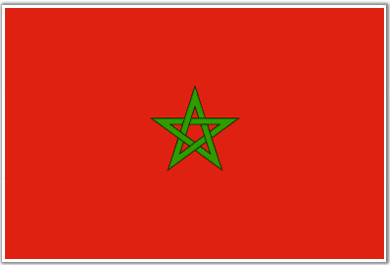
The flag of Morocco is a deep red with a green five-pointed star, or pentagram, at its center which represents the 5 Pillars of Islam.  The pentagram is outlined in black. Red has many important meanings for Morocco, reflecting the nation's history. Red has been used in Morocco to represent the royals, including the Alaouite family who ruled in the seventeenth century, and the Sherifs of Mecca and the Imams of Yemen. The red symbolizes bravery and strength.